

Welcome back to AI Operator: the weekly newsletter for integrating AI into every vertical of your internet business. Over the last week we added 223 subscribers, taking us to 4,409 total AI Operators. If someone forwarded this to you, subscribe here.
As AI becomes increasingly powerful, what becomes more important?
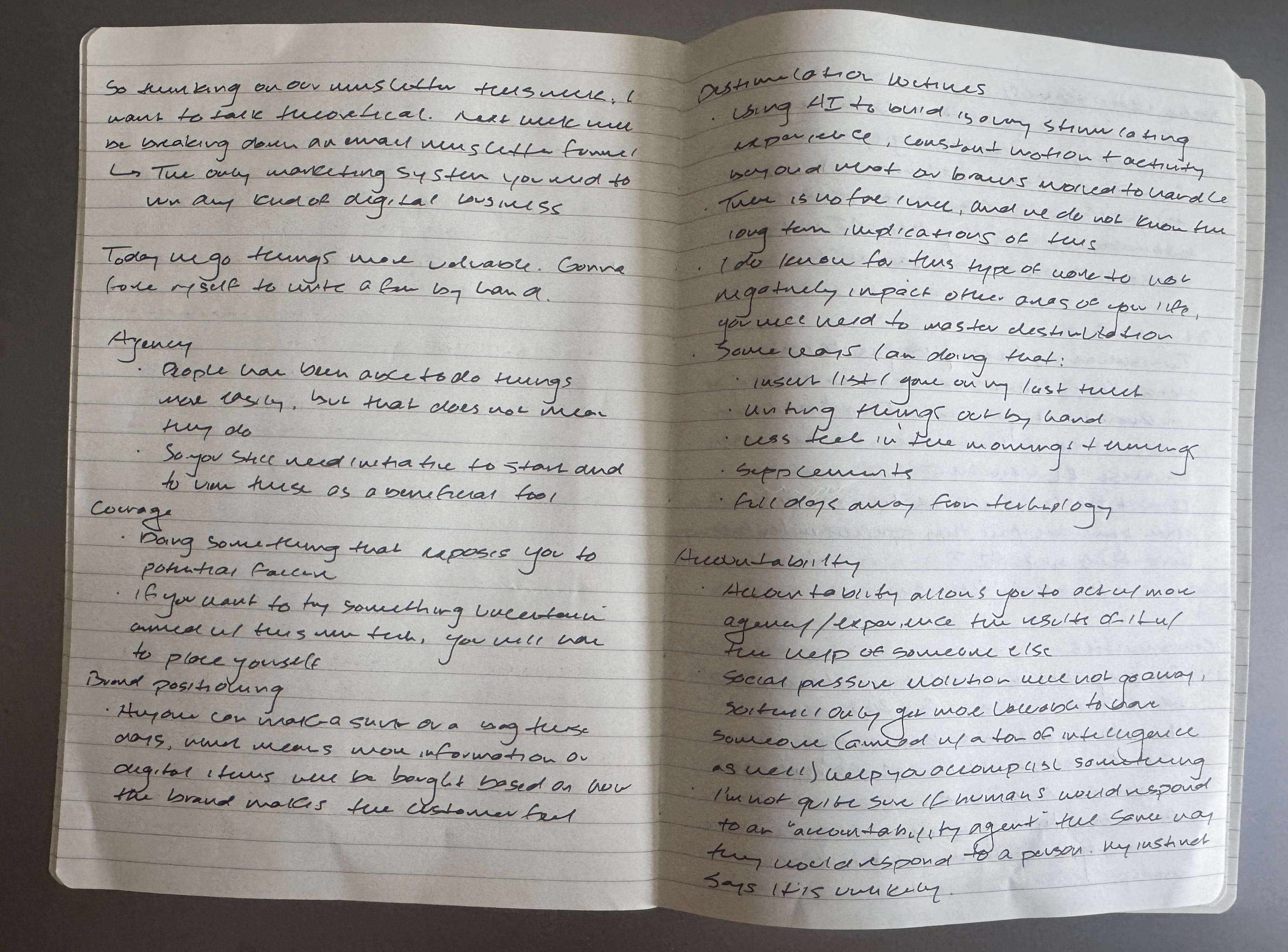
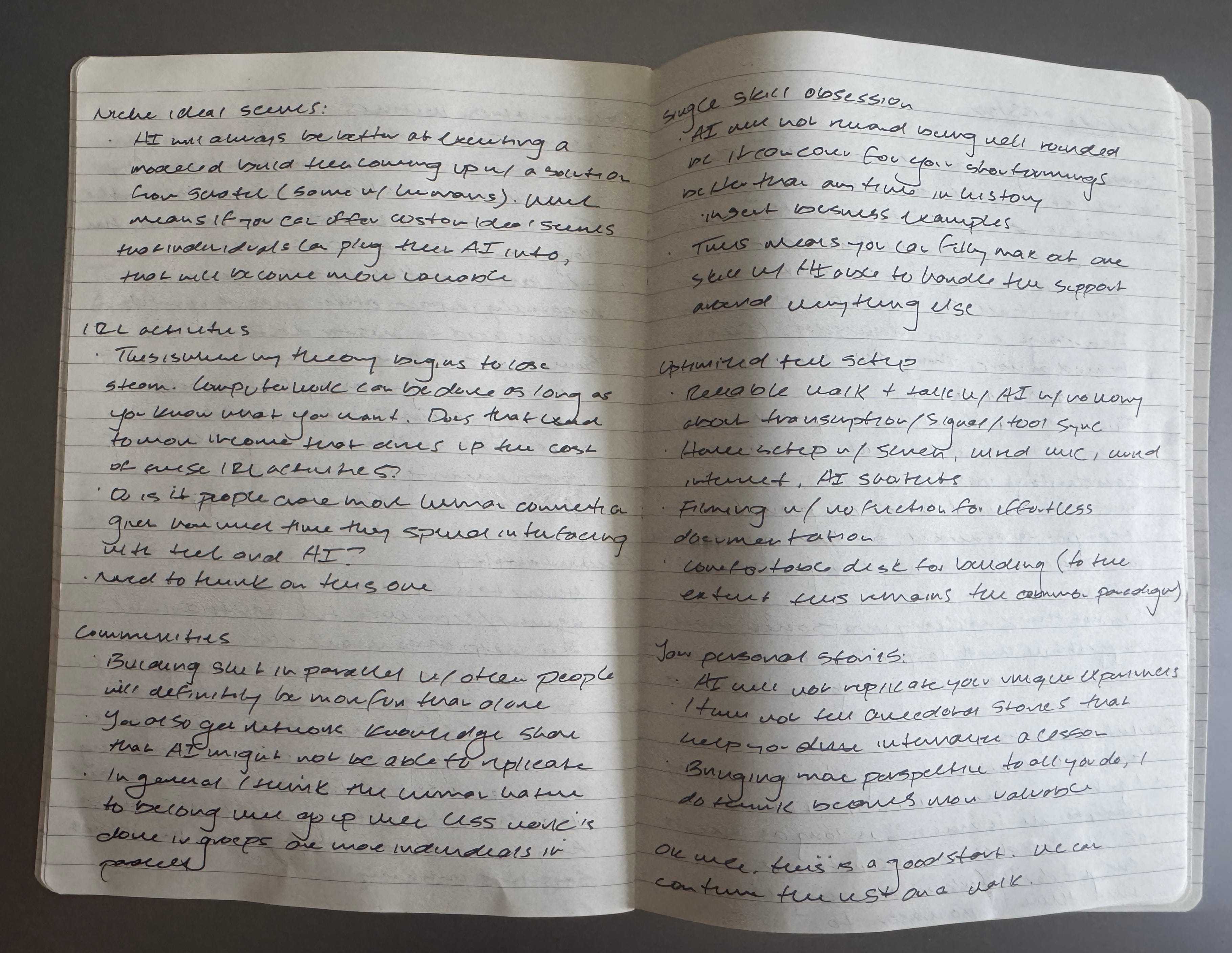
That’s a question I spent time reflecting on this week, armed with just my Muji pen & notebook.
And today I want to share 13 of my answers, as they might help you think through what to build, what skills to develop, and where to allocate your time and attention.
Here’s the full list we’re going to cover:
Agency
Courage
Judgment
Accountability
Attention spans
Destimulation routines
Optimized tech setup and workspace efficiency
In-person activities
Communities
Single-skill obsession
Plug & play agent workflows
Your personal stories
Proof & brand positioning
Now let’s take a closer look at each.
1. Agency
Let’s define agency as the amount of action you take to solve problems or pursue goals.
Just because people have more potential to do things does not mean more people will do them.
And this is not suddenly a new phenomenon. Technology has, for a long time, made it easier to do things. Yet only a small percentage of people ever do anything with it.
Take the fact that I am writing this newsletter to you right now. There has never been an easier time in human history to share your ideas. Yet, there are still people who do not do it, despite it being as easy as it has ever been. And this has been true through every iteration of this technology.
When ink & paper made it easier to share your ideas, everyone didn’t magically become a writer
When the printing press made it easier to share your ideas, everyone didn’t magically become a writer
When blogs made it easier to share your ideas, everyone didn’t magically become a writer
When AI made it easier to share your ideas, everyone didn’t magically become a writer
There’s no reason to think this trend will reverse in the future.
Every time a technology improves, there’s a group of people who immediately embrace it and use it to its full potential. These are the high-agency people who shape the world.
If you want to experience all of the benefits of AI, you still need to provide direction, make decisions, pursue opportunities when they present themselves.
So while AI increases what each action can accomplish, you still have to take action.


2. Courage
Let’s define courage as taking actions that expose you to potential failure or rejection.
Examples of things that take courage:
Starting any new initiative
Publishing a piece of content
Talking to someone you’ve never met but want to meet
Sending an outreach message to a potential client
Signing up for a health challenge or event
Making an investment in yourself or your business
AI can help you better prepare to take these actions, but you still have to be the one to publish, send the message, or make the commitment.
And therefore, no matter how much intelligence is on your side, you will still need to overcome the resistance that comes from taking any courageous action.
3. Judgment
Much has been said about “taste” being the new moat.
I prefer the word judgment, because every definition of taste seems to use judgment in its definition, which makes me think this is the more accurate word to use.
I define judgment as your ability to:
Decide between a set of options
And articulate the reasoning behind your decision
As AI tools get more powerful, more of the work humans do will shift from doing to deciding.
You make judgments on a handful of big things, with the three most important ones being:
Deciding what you want (and don’t want)
Deciding how to get what you want (and how not to get it)
Deciding if what you’ve built is good enough (and what to improve if it isn’t).
Those who get the most benefit from this technology will be the ones who make better decisions about what to pursue, what to build, and what to improve on the path to getting there.
4. Accountability
Accountability is the best way to increase your agency & courage.
When you have someone working directly with you overseeing your progress (or lack of progress), you are more likely to take action.
Why is that?
Because accountability creates a source of reinforcement that we would not have otherwise.
When you do something good, someone holding you accountable will provide positive reinforcement
When you do something bad, someone holding you accountable will provide negative reinforcement
Each of these makes you more likely to repeat the good action or avoid the bad action in the future.
For example, when you have a personal trainer versus working out by yourself:
Just for showing up to the workout, you get a high-five and a smile (positive reinforcement)
If you want to miss a workout, you would have to call in, cancel the session, pay the cancellation fee, and hear a small lecture from your trainer on how skipping workouts will not help you reach your goals (negative reinforcement)
Now, given how much more powerful we are as individuals when using the full power of AI, the rewards for taking action are higher than ever before.
And therefore, the value of someone helping us take action is higher than ever before as well, which is why we run Ship 30 for 30 as a cohort.
The 600+ writers who are already signed up are far more likely to take action when surrounded by the momentum of a group, compared to trying to start on their own.
5. Attention spans
Right now, AI can do a tremendous number of things, but they aren’t instant.
And if you’ve spent time building things with heavy AI assistance, you’ve probably experienced this:
You give a set of instructions for a task you want completed
It responds with a proposed plan of action
You review the plan and sign off on it for it to build
Then you immediately pull out your phone and start scrolling until it comes back to you with its progress
I do this more often than I’d like to admit, and it’s something I want to improve.
I actively feel my brain less able to focus on something for a long period of time, despite building more things than I ever have before.
A few ways I am thinking about combatting this to preserve my attention span:
Do more of my work while walking. I can give the same instructions I would give while sitting at my desk, but then put my phone away and think more about the problem while I move around. To me, it’s much easier to do this when I’m walking versus sitting at my desk.
Writing things down by hand while I work. When AI is executing something for me, I want to avoid going and clicking around aimlessly until it’s done. And I think an easy way to do that is to write out my next steps by hand, since (like walking) it forces me to think and not consume.
Orchestrating multiple windows at a time. This might not strengthen my attention span, but at least it will make my default “while AI does something” activity more productive than scrolling on my phone. To implement this, I will usually fork the chat I’m in while it’s building, then ask what the next steps are that I could get ahead on while the other task is being completed.
I don’t have a perfect solution to this one yet, but I know that the person who can maintain their ability to focus, while also using AI to build tons of things, will beat the person who loses theirs.
6. Destimulation routines
If you’ve started to intensely build projects with AI, you’ve recognized it is a very stimulating experience.
There’s constant motion as chat windows relay back results & agents whip around different windows
There are multiple things being built in parallel, which require you to context switch between them
And the only limitation is your ability to process the information and allow the building to proceed
I have a feeling that there will be negative long-term consequences to working in this way, because it’s delivering more information to our brains than we’ve evolved to handle.
For example, I spend most of my workday inside a small private office inside a bigger coworking area. Whenever I come off a long build session and walk into the main area, I can tell my brain is in a bunch of different places and has not “cooled down,” which makes being present with others more challenging.
Now, this does not mean I am going to avoid building this way, because there are real productivity benefits to doing so. But for it not to negatively impact other areas of your life, you will need to master the art of destimulation.
A few of the ways I’m doing that include:
Starting my day without any technology, only pen & paper
Ending my day without any technology, only pen & paper
Removing the ability to constantly work from my phone
Spending entire weekend days removed from technology
Supplementing with L-theanine in the morning & evening
I basically want to operate with a barbell of full technological immersion and full real-world immersion. If you’d be interested in reading a full piece on my approach to this, let me know in the comments.
7. Optimized tech setup and workspace efficiency
This is an area I am investing in heavily at the moment.
My goal is to set up my working environments to remove all friction involved with 1) producing content and 2) interacting with AI.
A few ways I am doing that:
Optimized walk & talk AI workflow
One of my favorite ways to make progress on a project is doing a long walk where I talk through the build order & get clear on exactly what I want.
But there are a few things that often keep me from doing that:
Friction from getting a new chat up and running
Shoddy transcription from my AirPods losing signal while I talk
Using the in-app transcription of OpenAI / Anthropic sometimes leads to transcription loss
I’m still dialing this in, but the goal is to start talking and trust that everything gets captured. I want to spend the walk thinking through the project, without having to stop and troubleshoot the tools.
Optimized desk setup
At my desk, I want it to be easy to settle into the work and take short breaks without completely breaking my flow.
That means:
Wide-screen monitor that immerses me in the workflow
Comfortable desk chair that I could sit in for multiple hours
Stretching equipment within reach to take short breaks
Blue-light blocking glasses to protect my eyes during long build sessions
Optimized filming setup
The same goes for filming. I want to make it easy to document what I’m building, without turning every recording into a whole production.
The setup I’m working toward:
Pre-set dimensions for recording my screen
1-click camera turn on
Always-on studio filming setup
Automatic footage upload
Streamlined editing process in Notion
As these tools become more capable, I want to remove all friction involved in using them.
And like the section before, if you’d be interested in reading a breakdown of how I set this up, let me know in the comments.
8. In-person activities
Do in-person activities become more important in the future?
I think so.
As a percentage of total time spent, most people will trend toward more time spent online than in the real world.
You will spend more time working in some kind of technological workspace, remotely engaging with virtual agents & virtual people from across the world
You will operate inside niche digital communities that bring people together who are interested in the same things that live nowhere near one another
You will engage in digital town squares that bring together voices & opinions of people who again live nowhere near one another
This trend has been going in one direction for the last 50 years, and I don’t see it reversing any time soon.
As a result, in-person activities become the “scarcer” resource, which should push their value up on a relative basis.
Setting up a virtual event will be nearly frictionless, which puts a premium on in-person events
Streaming virtual events will be nearly frictionless, which puts a premium on attending live
Talking to someone virtually will be nearly frictionless, which puts a premium on talking to them in person
The more of my life I can run through a screen, the more I value experiences that get me away from one.
And as a result, I’m more willing to pay for sporting events, travel, music concerts, dinners out, and anything else that lets me leave the internet at home for a while.
9. Communities
My general thesis is the number of one-person businesses will continue exploding higher over the next decade.
When AI allows you to “hire” it to handle specific functions within a business, it becomes exponentially easier to operate on your own.
However, I think there is a core human desire to work with other people.
But that doesn’t mean you have to work together, on the same thing, within a big business.
Instead, it could mean you work alongside others, on different things, in separate, one-person businesses.
And so I think communities where you can work & learn alongside other people will become more important.
People working together in a field will create networked knowledge-sharing that AI will not be able to replicate
When products change rapidly, customers will pay a recurring subscription to stay on the cutting edge.
Every big leap of progress I’ve had in my life came from something I learned inside a group, that I then sharpened by talking to others within the group
On top of that, I see the business model of running a paid community as the most ideal digital monetization method for a 1-person business owner, for a few reasons:
Paid communities can scale without scaling employee headcount, because the network itself becomes a support system
Building a community creates aligned incentives where you only win if you make it so people want to stay, which is better for customers
Plus, starting every month with an expected base of recurring revenue will help you make better long-term business decisions
And that’s why I’m going all in on building AI Writing Skool as the best place to build a business around your writing.
10. Single-skill obsession
“Generalists will win in the age of AI” is a horrible take.
Why on earth would you want to be mediocre at a bunch of things, when AI is smarter than you at nearly all of them?
Wouldn’t it instead make more sense to outsource every possible thing you can to AI, then go all in on the one thing (or small combination of things) at which you have a shot at being top 1% in the world?
For me, that skill is taking a complicated skill or idea, learning its fundamentals, and turning it into something more people can understand and act on.
In the past, building a business around that would involve a huge number of functions that are not “the main thing.”
Finance
Operations
Customer support
Building websites & landing pages
And most other business functions
These things still need to get done. But AI is only going to get better at handling them, which means you can spend less time on these and more time on the one thing around which you’re building the business.
And that’s the bet I’m making.
11. Plug & play agent workflows
When given the exact steps to complete a task, AI will complete it more efficiently than if it has to come up with the steps on its own, just like humans.
Which means any company with an agent model (like Muse, or OpenClaw, or whatever OpenAI or Anthropic come out with), will eventually have an “agent workflow marketplace” of some kind. Sure, these agents could all “figure everything out on their own.” But it would be more efficient (and therefore cost less for both the consumer & the provider), if they can tap into a pre-built workflow.
Now, AI will (like most things) make it easier to create these, especially generic versions. But the market will expand for hyper-specific agentic workflows for your exact situation & use case.
For example:
A generic workflow might help you take an idea and turn it into a newsletter
A specific workflow for a business coach might take all of their call notes from their weekly calls, pull out 3 recurring questions, and turn the most valuable one into a newsletter pulling exclusively from their approved set of language in previous pieces of writing, plus wrap it up with a congruent CTA and lead magnet for their coaching offer
Both of these use AI, but one is far more valuable to the specific person it is built for.
And that’s where I think the opportunity lives: building workflows that help one specific person do one specific job to accomplish one specific outcome.
12. Your personal stories
My co-founder Nicolas Cole put together an awesome piece breaking down the difference between commodity content & personality content. I highly recommend going to read that in full.
The quick summary is that AI is a commodity content machine - meaning it defaults to producing insights that have been repeated thousands of times already.
Because of this, the only way you can “differentiate” yourself is by wrapping up commodity content with personality content - which is content, stories, quirks, and lessons that you (and only you) can say.
AI may help you tell your stories, but it hasn’t lived the unique set of experiences that shaped who you are. So the more you can bring in all of the things you’ve tried, mistakes you’ve made, and the specific moments that changed how you think, the more you will stand out.
13. Proof & brand positioning
When anyone can replicate information, people will look for reasons to believe you.
Have you actually done the thing?
Have you forgotten more about the topic than most people will ever learn?
Have you transferred the skill to tons of other people already?
“Proof of work” becomes more valuable the easier information becomes to produce.
The same goes for products. Many products will have the same features, or competitors will be able to replicate those features nearly perfectly.
This means people will increasingly make purchases based on who’s behind the product, what they stand for, and whether or not you are aligned with their way of operating.
The easier it becomes to build something, the more you need to give people a reason to trust what you’ve built.
And that’s my whole list. Now I’d love to hear from you!
Which of these do you agree with?
Which do you disagree with?
What are some others that I missed?
Leave a comment and let me know. I read and respond to every one of them personally. And if you leave a comment that broadens my perspective, I’ll send you a surprise bonus via DM.
That’s it for today, thanks for reading!
Talk soon,
Dickie
PS: Today’s post was inspired by a tweet that got a lot of attention on X.

This is a great example of the lean writing process we’re teaching inside the upcoming Ship 30 for 30 cohort with a fully rebuilt curriculum. We start on October 5th. Join 600+ others already signed up here.
PPS: If you’re curious what this looked like before it became a newsletter, here’s the handwritten journal entry where I worked through my answers.
If you enjoyed this, here’s what to read next
GPT-6 Astra Has Completely Changed The Way I Run My Business. Here’s Why.

Welcome back to AI Operator: the weekly newsletter for integrating AI into every vertical of your internet business. Over the last week we added 224 subscribers, taking us to 4,186 total AI Operators. If someone forwarded this to you, subscribe here.

Loved this. What stuck with me from "13 Things" was how you walk to hear your own thoughts.
I've been doing a version of that. I draft, then have my phone read it back to me while I'm moving. It's the only way I catch what I'm actually saying.
I write The Formula Method and I'm working on an October post about inspiration. Would you mind if I referenced your piece and linked back?
Great read thank you